Top New Year Resolutions For Americans
Most of us entered 2020 with the usual suspects, exercise more, lose weight, eat healthier. Then March happened. And suddenly, we stopped following our new year resolutions.
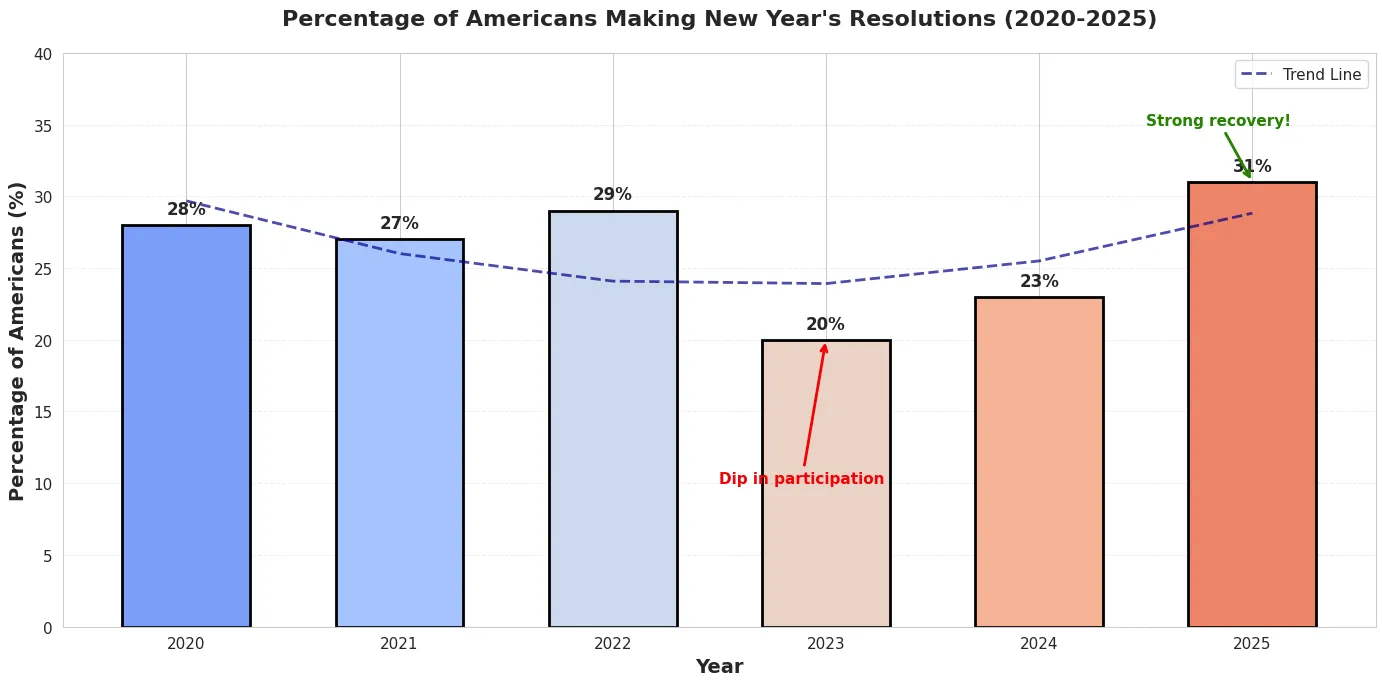
But what if we could actually see how the collective trauma of a global pandemic shifted our priorities? Not through think pieces or personal anecdotes, but through cold, hard data tracking what Americans actually resolved to do from 2020 through 2025?
You can access our analysed notebook here, this is the link.
When Everything Changed
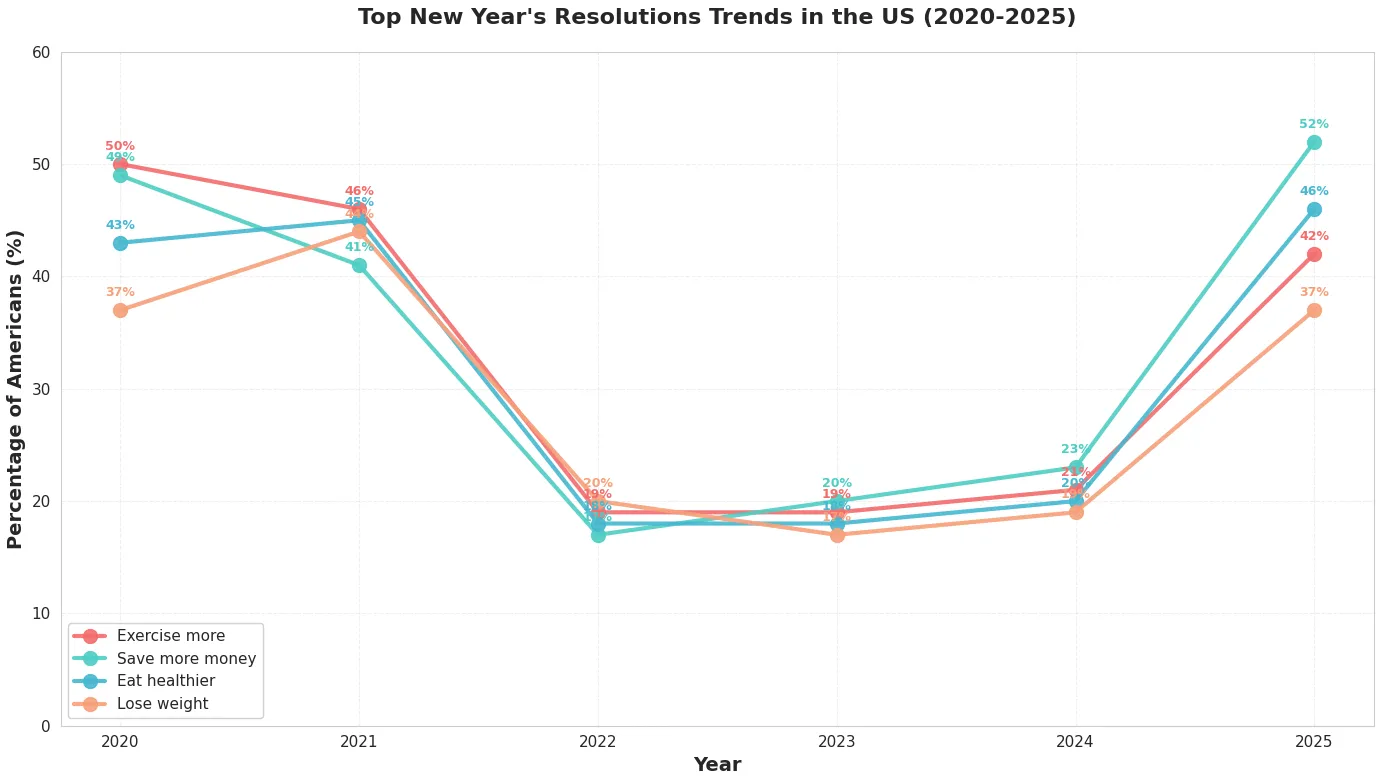
A comprehensive analysis of US resolution trends reveals something fascinating: we didn’t just change what we wanted, we fundamentally altered why we wanted it. By examining consumer survey data across six years and 13 different resolution categories, the patterns that emerge tell a story about resilience, adaptation, and what happens when the world forces you to recalibrate your entire life.
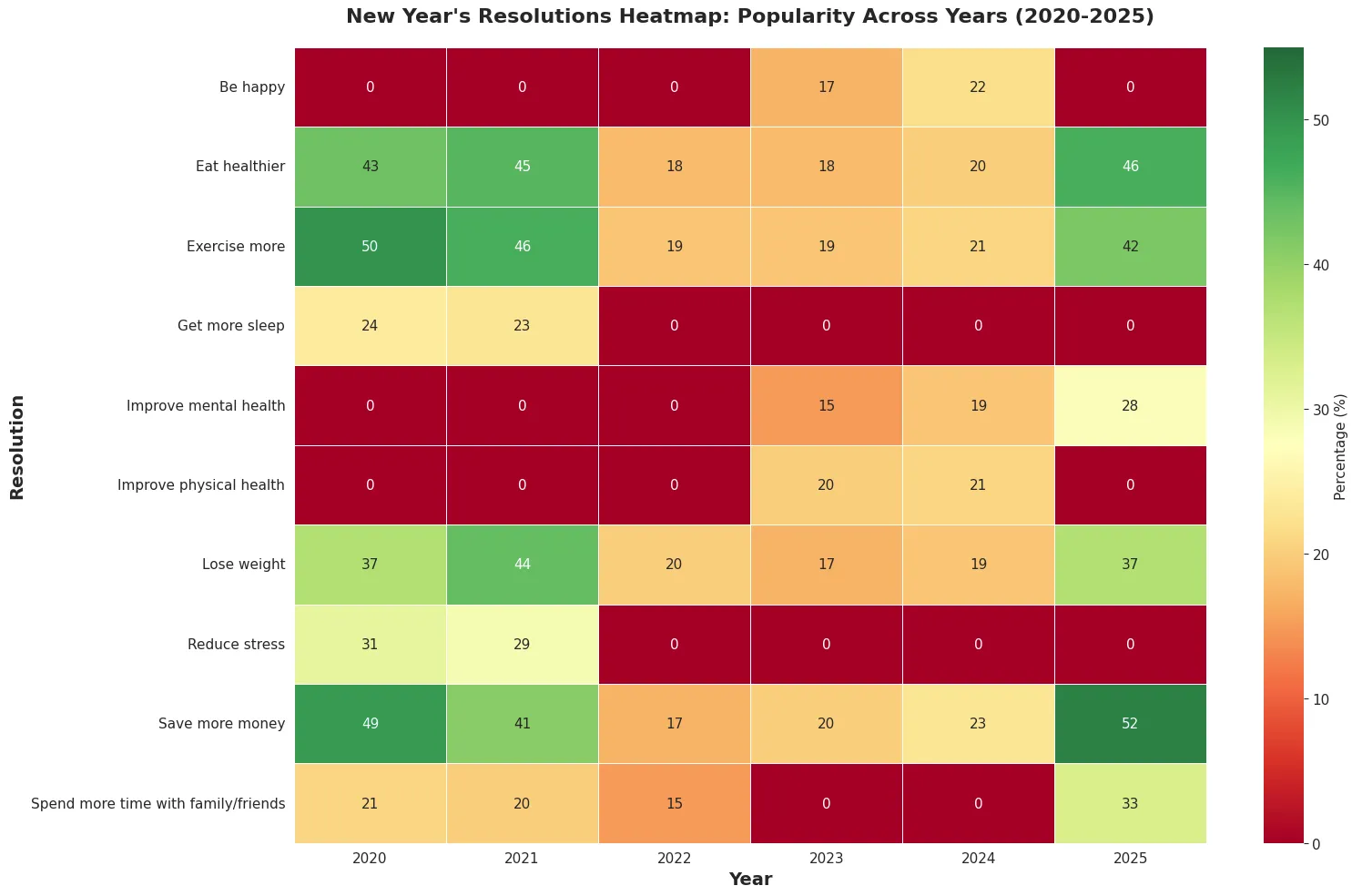
Let’s start with the headline number that should make every financial advisor simultaneously excited and concerned: in 2025, 52% of Americans resolved to save more money. That’s the highest it’s been since 2020, when it hit 49%.
Now, you might think “so what? People always want to save money.” Except here’s the thing, in 2022 and 2023, that number dropped to 17% and 20% respectively. We’re not just seeing a trend; we’re watching people’s financial anxiety written in data form.
The Financial Panic is Real
You know what’s quietly terrifying? The fact that “save more money” overtook “exercise more” as the top resolution for 2025. That hasn’t happened in years.
Think about what that means. Exercise has always been number one, it’s the resolution equivalent of ordering fries with your salad. It makes us feel virtuous while being specific enough to measure but vague enough to abandon by February. But in 2025? People are more worried about their bank accounts than their waistlines.
The data shows exercise resolutions peaked at 50% in 2020, then crashed to 19% in both 2022 and 2023. By 2025, it recovered to 42%, respectable, but still beaten by financial concerns.
This isn’t just interesting; it’s diagnostic. When people prioritize money over health, they’re not being shallow, they’re being realistic. Inflation, economic uncertainty, and the lingering effects of pandemic-era financial disruption have fundamentally changed how Americans approach their goals.
The Weight Loss Rollercoaster
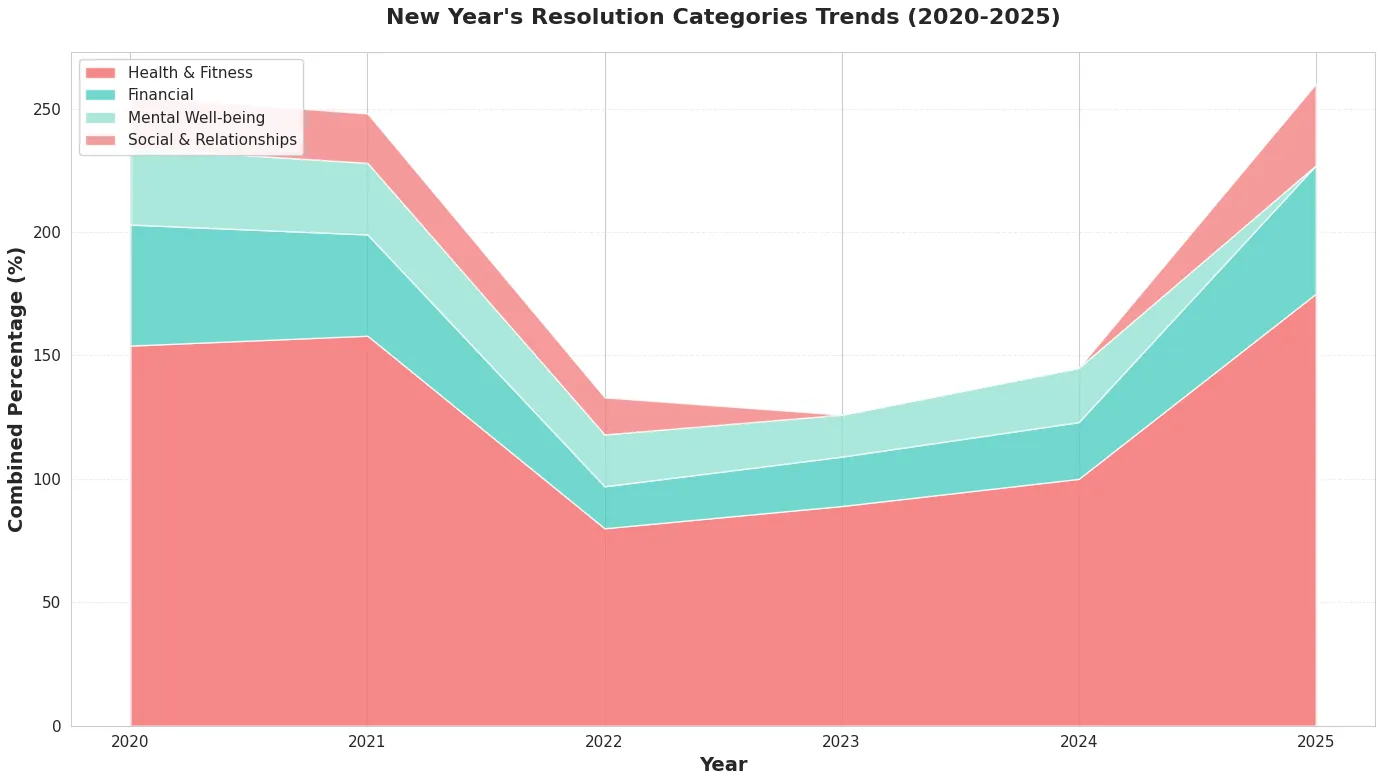
Let’s talk about weight loss, because this particular category tells a story about optimism, defeat, and eventual acceptance.
In 2020, 37% of Americans wanted to lose weight. By 2021, that number jumped to 44%, the post-lockdown “oh god, what have I become” moment we all experienced when we had to wear real pants again. Then it plummeted to 20% in 2022, stayed low at 17% in 2023, crept up to 19% in 2024, and rebounded to 37% in 2025.
That U-shaped curve? That’s what resignation followed by renewed hope looks like in graph form.
But here’s the really interesting part: “eat healthier” maintained more consistent levels, sitting at 46% in 2025 compared to 43% in 2020. People might have given up on losing weight during the weird middle years, but they never stopped wanting to eat better. Maybe we collectively realized that health isn’t just about the number on the scale, or maybe we just got better at framing our goals.
The Years We Gave Up
Speaking of those weird middle years, 2022 and 2023 represent the resolution wasteland. Almost every category took a nosedive.
Exercise? Down. Saving money? Down. Even reducing stress dropped from 31% in 2020 to unmeasured levels (probably because everyone was too stressed to even think about reducing stress, which is peak 2023 energy).
Only two categories maintained some momentum: eating healthier hung on at 18% (we’re nothing if not persistent about our dietary delusions), and getting more sleep stayed at 24%. Turns out, when everything is terrible, “just let me sleep” becomes a legitimate life goal.
But 2024 marked the turning point. Resolution rates started climbing again across the board, not back to 2020 levels yet, but moving in the right direction. By 2025, we’re seeing a full-scale recovery with some categories even exceeding pre-pandemic numbers.
The Rise of Mental Health Awareness
Now let’s address what might be the most important shift hidden in this data: the growing acknowledgment of mental health as something worth prioritizing.
In 2020, 31% of Americans resolved to reduce stress, a number that feels quaint now, given everything that came after. But here’s what’s fascinating: while the data for 2023-2024 shows gaps in mental health tracking (probably because the entire concept felt futile), by 2025, mental wellness has emerged as a permanent fixture in the resolution landscape.
Recent surveys show that 33% of Americans are making mental health resolutions in 2025, with younger generations leading the charge at 48% for 18-34 year olds. Compare that to just 13% of those 65 and older, and you’re seeing a generational divide in how we conceptualize wellness.
This isn’t just people wanting to “feel better”, it’s a fundamental recognition that mental health is health. The pandemic didn’t just stress us out; it normalized talking about being stressed out. And the data reflects that cultural shift.
The Social Reconnection Imperative
Here’s something easy to miss in the numbers: “spend more time with family and friends” represented 21% of resolutions in 2020, dropped to 20% in 2021, disappeared from the tracked categories until 2025, when it surged to 33%.
That gap? That’s Zoom fatigue, isolation fatigue, and “I literally cannot look at another human face even on a screen” fatigue all rolled into one. But the 2025 spike tells us something important: we’re done being isolated. We’ve remembered that humans are social animals, and three years of forced distance has made us desperately crave genuine connection.
Think about what 33% means. One in three Americans is explicitly saying “I need to invest in my relationships.” That’s not just a resolution; that’s a collective cry for help from a society that realized too late what it was sacrificing.
Breaking Down the 2025 Landscape
So where does that leave us now, as we navigate this post-pandemic, economically uncertain, mentally exhausted era?
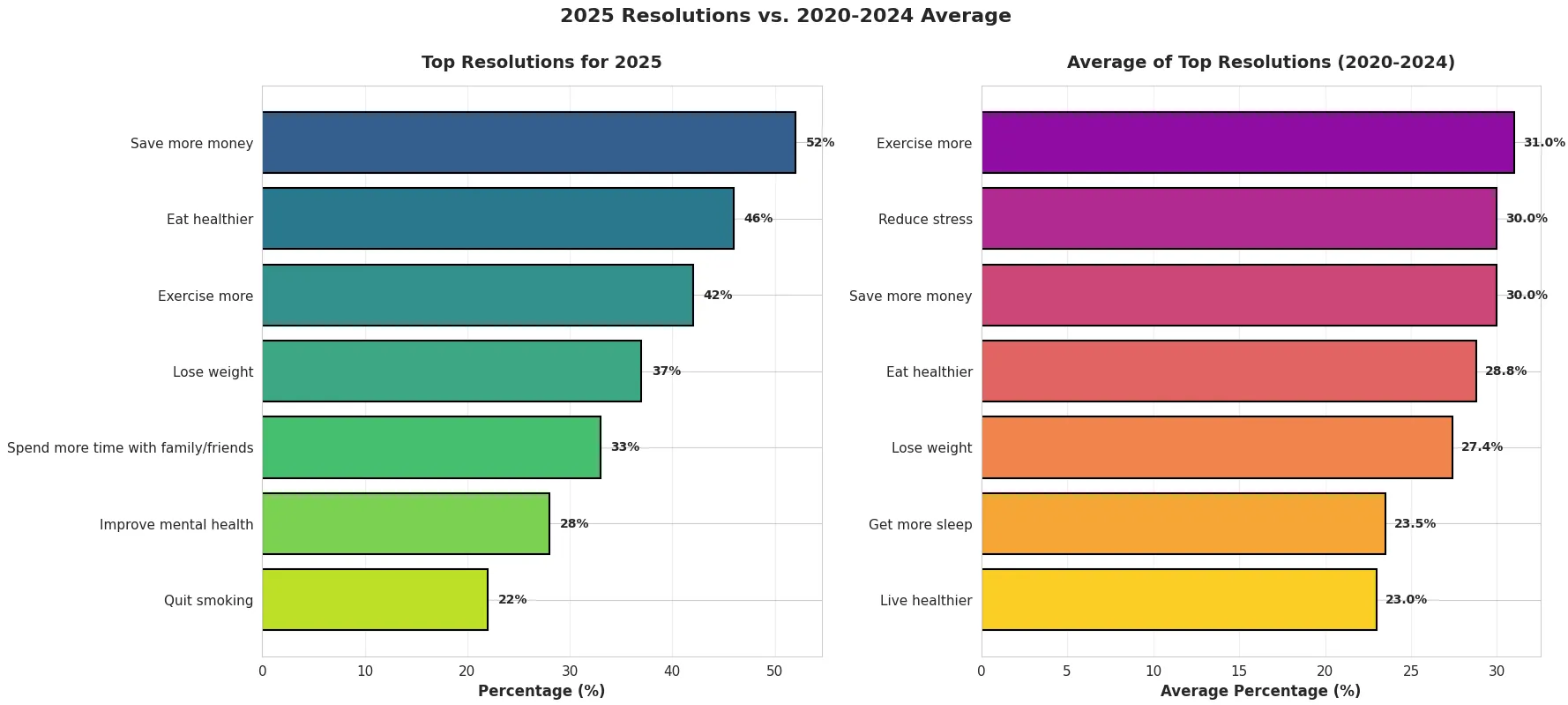
The data paints a clear picture:
Financial Anxiety Dominates
52% saving money, 23% focused on general financial management. People aren’t just worried, they’re actively strategizing.
Health Still Matters
42% exercise, 46% eat healthier, 37% lose weight. The traditional triumvirate is back, but competing with more pressing concerns.
Mental Wellness is Non-Negotiable
Between stress reduction and mental health focus, about a third of Americans are prioritizing their psychological wellbeing. That’s not a trend; that’s a movement.
Social Connections Matter
33% explicitly wanting more family time represents a dramatic reversal from the isolation years.
What’s missing from 2025? Anything related to career advancement or productivity. Which tells you everything about where we are collectively, survival and wellbeing trump ambition.
The Generational Divide
If you really want to understand what’s happening, you have to look at who’s making these resolutions.
Under 30
Leading the charge on financial goals (47% saving money) but also the most likely to make mental health resolutions. They’re trying to build stability while acknowledging they’re not okay, a remarkably mature combination.
30-44
Split between saving money (31%) and mental health (23%). Classic millennial energy: financially stressed but self-aware enough to know they need therapy.
45-64
Physical health (23%) and healthy eating (21%) dominate. Gen X is doing what they do best, trying to maintain order through discipline.
65+
Barely making resolutions at all (only 14% plan to), but when they do, it’s about physical activity. They’ve earned the right to stop caring what January thinks they should do.
The fascinating part? Younger people are more likely to actually keep their resolutions. 40% of resolution-makers say they’ll stick with it all year, while 50% think they’ll probably maintain it. Only 7% are already planning to fail, which is either optimistic or delusional depending on your perspective.
Built with Livedocs
Creating an analysis like this used to be a nightmare of scattered spreadsheets, multiple software tools, and probably at least one complete meltdown when Excel crashed for the third time.
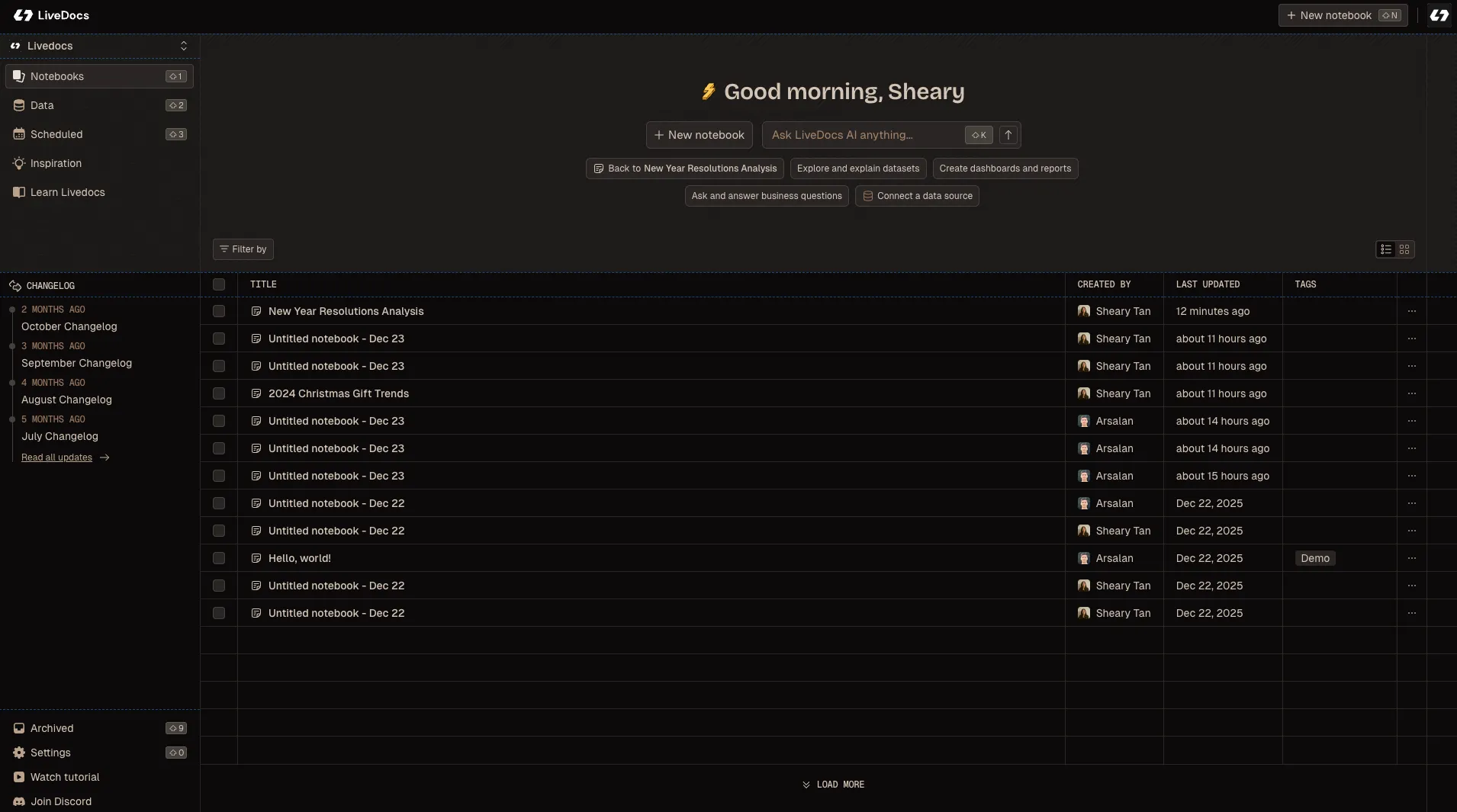
The New Year’s Resolutions Analysis notebook was built using Livedocs, the best data analysis platform out there.
Why This Matters for Data Work
Here’s the thing about tracking resolution trends across 42 data points, 6 years, and 13 categories: it requires serious data manipulation, visualization capabilities, and the ability to tell a story. Traditionally, you’d need Python or R for analysis, Tableau or Excel for viz, and then copy-paste everything into a document while praying nothing breaks.
Livedocs flips that entire workflow. It’s a collaborative notebook environment where SQL queries, Python analysis, visualizations, and explanatory text all live together in perfect harmony.
Think of it as Jupyter notebooks for people who have better things to do than troubleshoot kernel errors.
The AI Advantage:
When you’re working with resolution data and realize you need to group categories differently or create a new visualization type, Livedocs’ AI assistance can help write the code, optimize queries, or suggest better approaches.
Real-Time Collaboration
Multiple analysts can work on the same notebook simultaneously. One person updates the SQL query pulling in 2025 data, another generates new visualizations, and a third adds context about what the trends mean, all happening live, all staying synchronized. No more “Final_FINAL_v3_ActuallyFinal.xlsx” situations.
Smart Execution
Because Livedocs understands dependencies between different code cells, it only runs what needs running. When you update the 2025 data, it automatically knows which visualizations need refreshing without re-running your entire analysis. This isn’t just convenient when dealing with years of resolution trends, it’s the difference between waiting 10 seconds and waiting 10 minutes.
Flexible Access
Technical team members can write complex Python to calculate percentage changes and statistical significance, while non-technical stakeholders can use the no-code interface to explore the same data and generate their own insights. Everyone works in the same space without needing to translate between tools.
Publication Ready
When your analysis is done, you can share it as an interactive notebook where readers can explore the data themselves (perfect for researchers or journalists), or publish it as a polished report with all the code hidden (ideal for executives who just want the insights). No separate presentation deck required.
For the resolutions analysis specifically, this meant the creators could iterate quickly on which categories to track, test different visualization approaches to show the dramatic 2022-2023 drop, and add contextual analysis about what the trends mean, all without the technical friction that usually bogs down data projects.
What It All Means
So what should we actually do with this information? A few thoughts:
If You’re Making Financial Resolutions
You’re not alone, and you’re not wrong. Half the country shares your concerns. But remember that saving $10 a week still counts, financial goals don’t have to be dramatic to be meaningful.
If You’re Focusing on Health
The data suggests that “eating healthier” has more staying power than “losing weight.” Maybe frame your goals around behavior (what you eat) rather than outcomes (what you weigh).
If Mental Health is Your Priority
You’re part of a growing movement, especially if you’re under 45. And here’s the secret: mental health resolutions are the ones most likely to improve everything else. Hard to save money when you’re too anxious to look at your bank account.
If You’re Not Making Resolutions at All
Honestly? Also valid. The data shows that older Americans have largely opted out of the resolution game, and they seem fine. Sometimes the best resolution is accepting that you don’t need constant self-improvement.
Final Thoughts
The resolution trends from 2020-2025 tell us something important: we’ve been through hell, and we’re still trying to get better. That persistent optimism, even when resolution rates crashed in 2022 and 2023, represents something fundamentally human and kind of beautiful.
We keep trying. We adjust our priorities based on circumstances. We acknowledge when mental health matters more than physical fitness, or when financial stability trumps everything else. And then, when things stabilize slightly, we start adding back the other goals we care about.
The fact that 2025 shows recovery across almost every category isn’t just statistical noise, it’s evidence that collectively, we’re healing. Slowly, inconsistently, imperfectly, but genuinely.
Whether individual resolutions succeed or fail (and let’s be honest, most fail by March), the act of making them represents hope. The data shows that despite everything, pandemic, economic chaos, social isolation, general existential dread, people still believe they can improve their lives through conscious choice.
And maybe that’s the real resolution worth keeping: the belief that tomorrow can be better than today, even when the data suggests otherwise.
The best, fastest agentic notebook 2026? Livedocs.
- 8x speed response
- Ask agent to find datasets for you
- Set system rules for agent
- Collaborate
- And more
Get started with Livedocs and build your first live notebook in minutes.
- 💬 If you have questions or feedback, please email directly at a[at]livedocs[dot]com
- 📣 Take Livedocs for a spin over at livedocs.com/start. Livedocs has a great free plan, with $10 per month of LLM usage on every plan
- 🤝 Say hello to the team on X and LinkedIn
Stay tuned for the next tutorial!
Ready to analyze your data?
Upload your CSV, spreadsheet, or connect to a database. Get charts, metrics, and clear explanations in minutes.
No signup required — start analyzing instantly