Super Bowl LX: The Winner
🏆 PREDICTED WINNER: PHILADELPHIA EAGLES
February 8, 2026. Mark it on your calendar. That’s when Super Bowl LX kicks off in Santa Clara, California, and if you’re placing bets now, you might want to seriously consider the Philadelphia Eagles.
It’s only December 1st, and we’ve got weeks of football left. Injuries happen. Teams collapse. Dark horses emerge. But here’s the thing: when you crunch the numbers, analyze the matchups, and factor in that intangible playoff experience, the Eagles keep rising to the top like cream in your morning coffee.
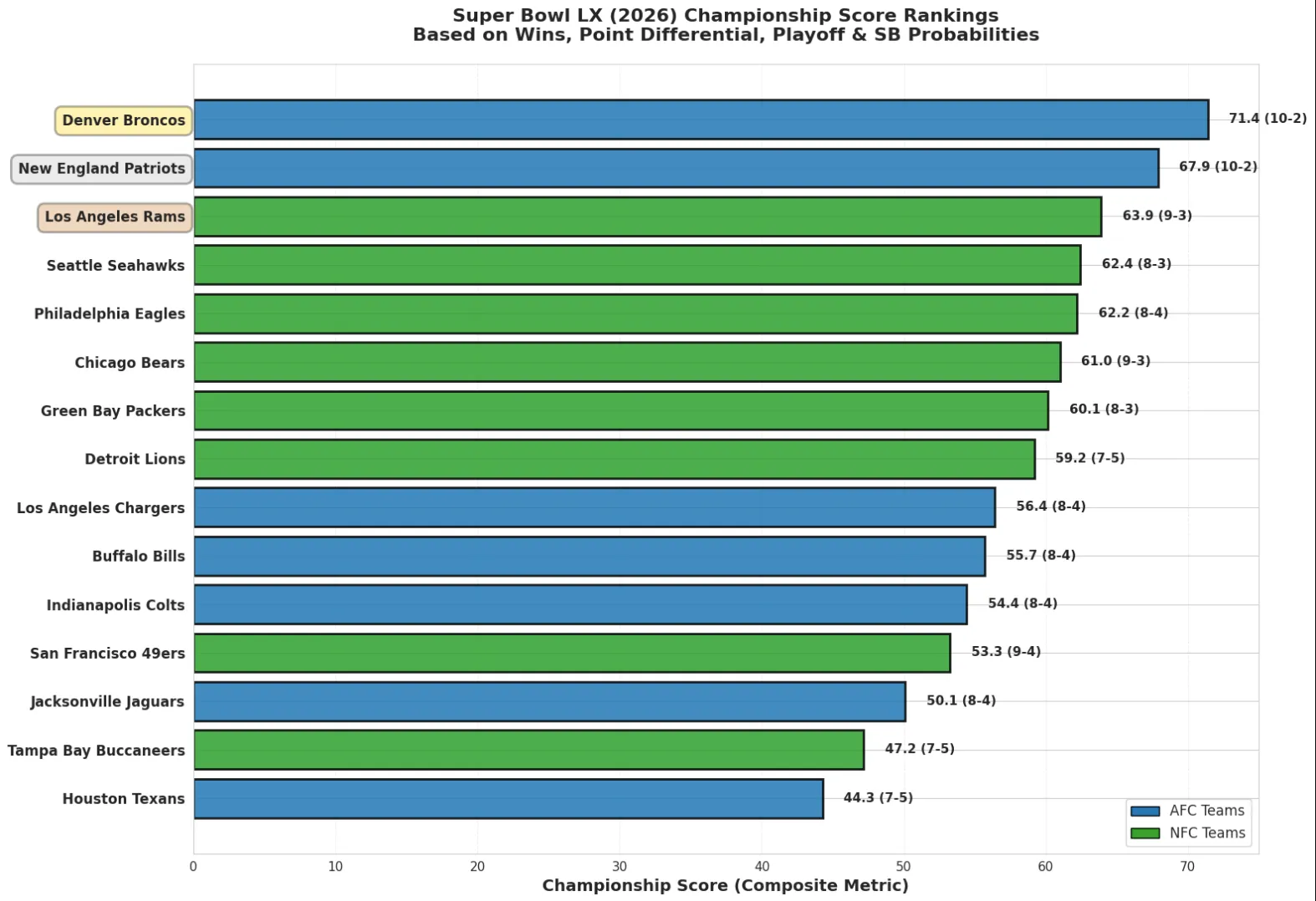
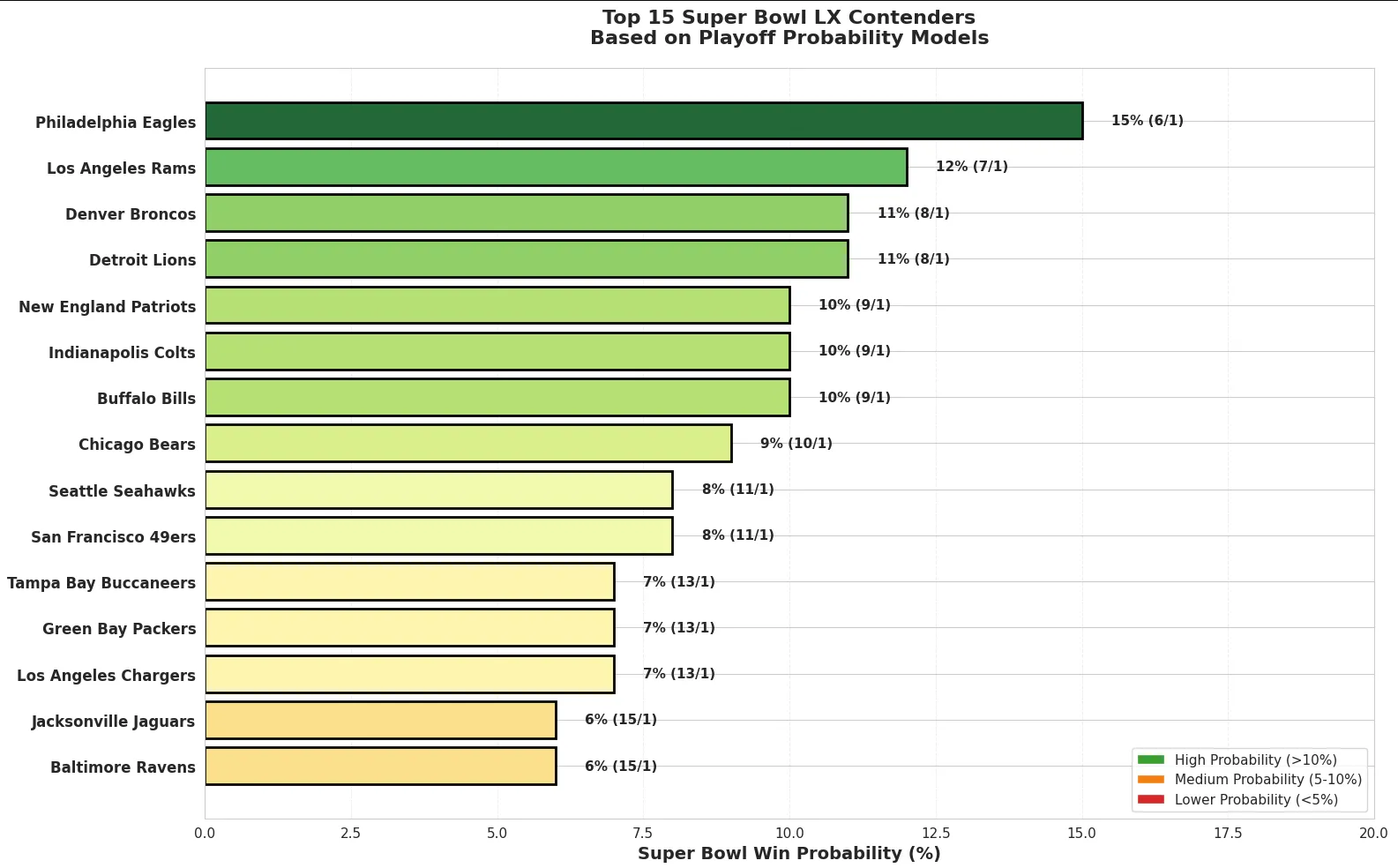
Their championship score? 68.3. That’s the second-highest overall, and they’re leading the NFC East with an 88% chance to win their division. More importantly, they’ve got 6/1 odds, the best among all NFL teams right now. Not bad for a squad that’s already tasted Super Bowl glory recently and knows exactly what it takes to get there again.
And here we are using Livedocs Deep Research Agent to pull up 20+ resources and data across the internet to do the analysis.
You can access the notebook here, this is the link
The Contenders
Let’s break down the field, because while everyone loves a Cinderella story, championship football tends to reward teams that check multiple boxes simultaneously.
Philadelphia Eagles
Sit at the top with their balanced attack and championship pedigree. Jalen Hurts has evolved into a dual-threat quarterback who doesn’t just manage games, he wins them. The Eagles don’t dominate in one area; they’re good at everything. Defense? Solid. Offense? Explosive when needed. Special teams? Reliable. That balance matters when you’re playing four quarters against the league’s best.
Denver Broncos
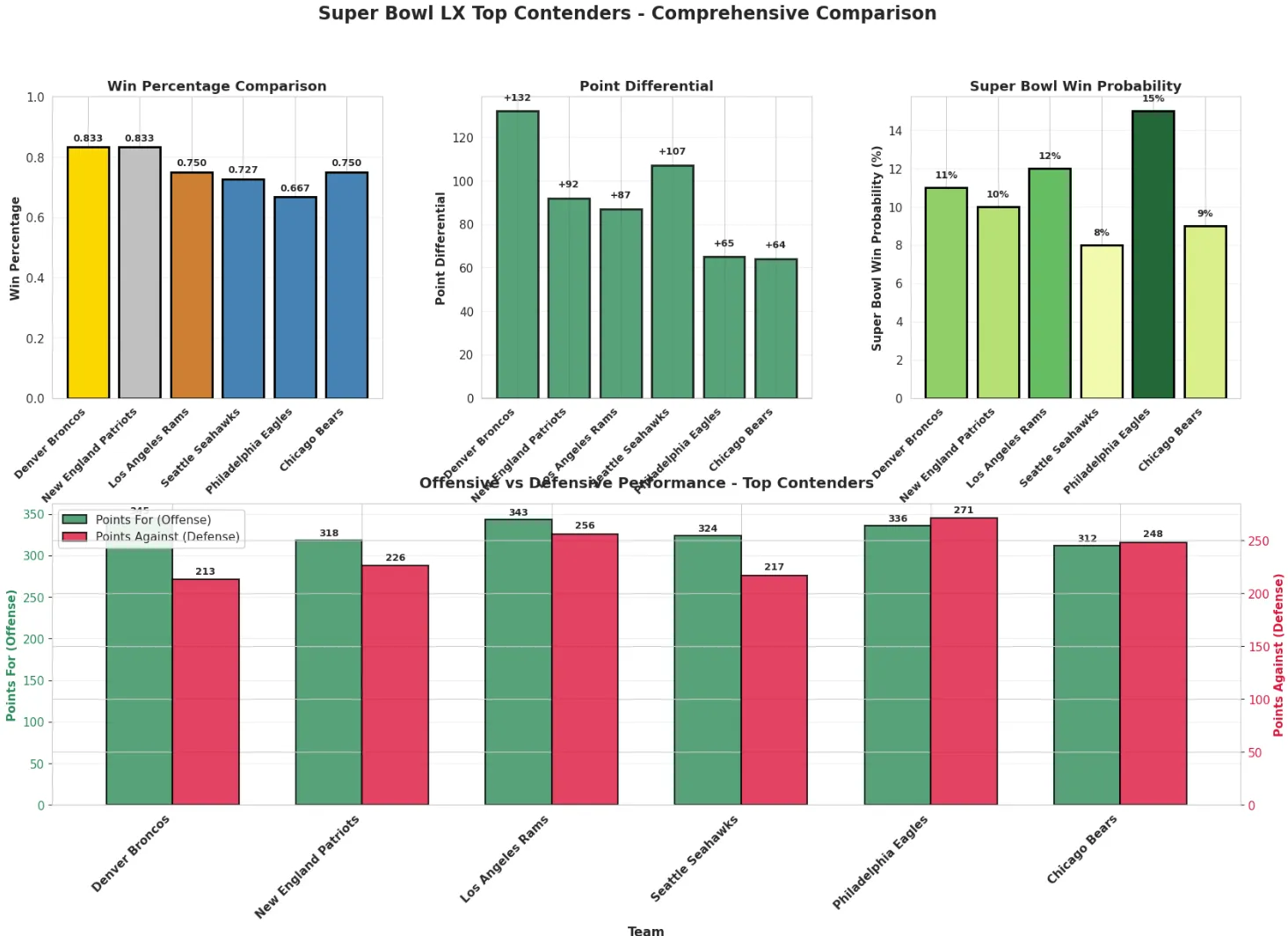
Are the statistical darlings with a 71.4 championship score and a point differential of +132. That’s elite territory. But here’s where it gets tricky, they lack playoff experience, and the AFC West isn’t exactly forgiving. Playing Kansas City and the Chargers twice a year builds character, but it also wears you down.
Los Angeles Rams
Brings Matthew Stafford’s veteran savvy and a balanced roster that’s battle-tested. They’ve got 7/1 odds for good reason. The concern? Their remaining schedule includes the 49ers and Seahawks twice. That’s a gauntlet, and inconsistency in close games could derail them before they ever reach the playoffs.
Buffalo Bills
Features Josh Allen playing at MVP, caliber levels. When he’s on, the Bills can beat anyone. When they’re not? Recent playoff disappointments haunt this franchise like ghosts in the film room. Mental hurdles against top-tier teams are real, and until Buffalo exorcises those demons, they’re more “dangerous contender” than “heavy favorite.”
Detroit Lions
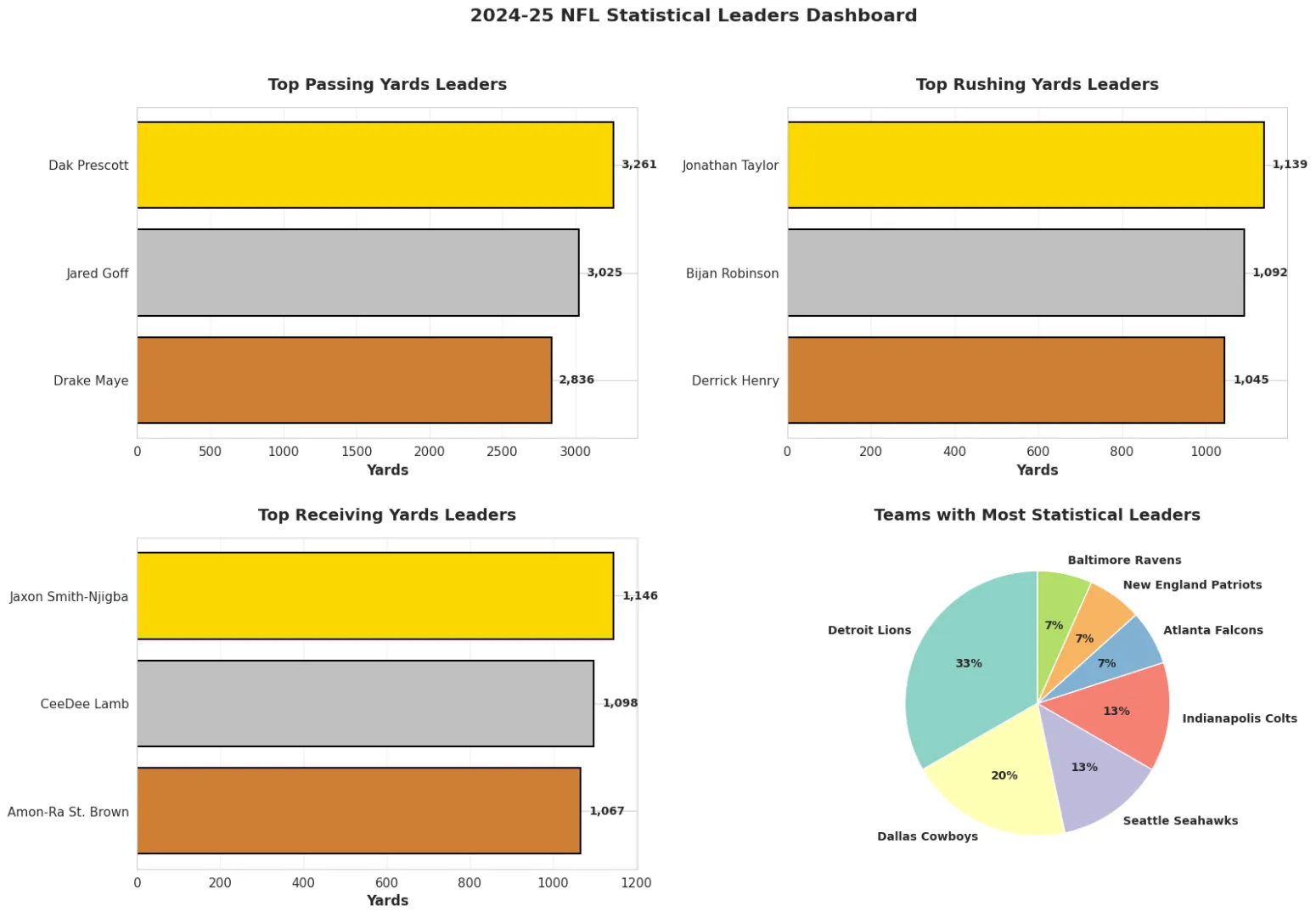
Are fascinating, Jared Goff is putting up a 110.2 QBR with 3,025 passing yards, and the offense can explode at any moment. But that 7-5 record is concerning. Inconsistent performances in a league where every game matters means you’re always one bad Sunday away from sliding down the playoff ladder.
The Numbers Don’t Lie
You want statistical truth? The Eagles have a +65 point differential, which sits in that optimal championship range, dominant enough to show quality, but not so inflated that it suggests unsustainable blowouts. Sustainability matters over a 17-game season plus playoffs.
Their 99% playoff probability is essentially a lock. Compare that to teams still fighting for wildcard spots, and you see the advantage of early positioning. Home-field advantage in the NFC playoffs could run through Philadelphia, and if you’ve ever watched a January game at Lincoln Financial Field, you know what a hostile environment that becomes.
The championship score formula breaks down like this: win percentage weighted heavily (×30), point differential factored in (/10), playoff probability added (×0.3), and Super Bowl probability included (×0.4). It’s not perfect—no model is—but it captures the multidimensional nature of championship football better than looking at wins alone.
Denver’s 71.4 score actually edges out Philadelphia’s 68.3, which tells you raw dominance matters. But championship football isn’t played in spreadsheets. It’s played in hostile stadiums during freezing weather with everything on the line, and that’s where experience becomes currency.
The Injury Factor
Let’s talk about what nobody wants to discuss but everyone’s thinking about: injuries.
High-impact injuries to monitor include key defensive players across multiple teams and offensive line depth, which quietly determines whether quarterbacks have time to throw or running backs have holes to hit. The Eagles, Rams, and Bills currently hold advantages in relative health. The Broncos and Patriots? Concerns are mounting.
Current injury reports shift daily, but the pattern is clear, teams that can manage load, rotate effectively, and keep key players fresh heading into January tend to outlast those running on fumes by Wild Card Weekend.
Jonathan Taylor’s 1,139 rushing yards for the Colts shows what a healthy offensive catalyst can do, but it also shows the workload concerns. Running backs break down. Quarterbacks take hits. Defensive playmakers accumulate bumps and bruises that compound over time.
Schedule Strength
Here’s where things get interesting. Remaining schedule difficulty isn’t just about wins and losses—it’s about preparation and momentum heading into the playoffs.
Easier remaining schedules favor teams like the Eagles and Bills, who can secure better seeding without beatdowns that risk injury or expose weaknesses opponents might exploit in January. You can rest starters in Week 18 if you’ve already locked up the one-seed. That’s luxury, not laziness.
Tougher remaining schedules challenge the Rams (facing 49ers and Seahawks twice) and Broncos (navigating the AFC West gauntlet). Sure, winning tough games builds confidence. But losing them costs seeding, momentum, and sometimes playoff berths entirely.
The impact here is straightforward: home-field advantage in the playoffs is massive. Crowd noise disrupts offensive communication. Weather favors the home team that practices in it weekly. Familiarity with field conditions, locker rooms, even hotel routines, these micro-advantages add up.
The NFC vs. AFC Divide
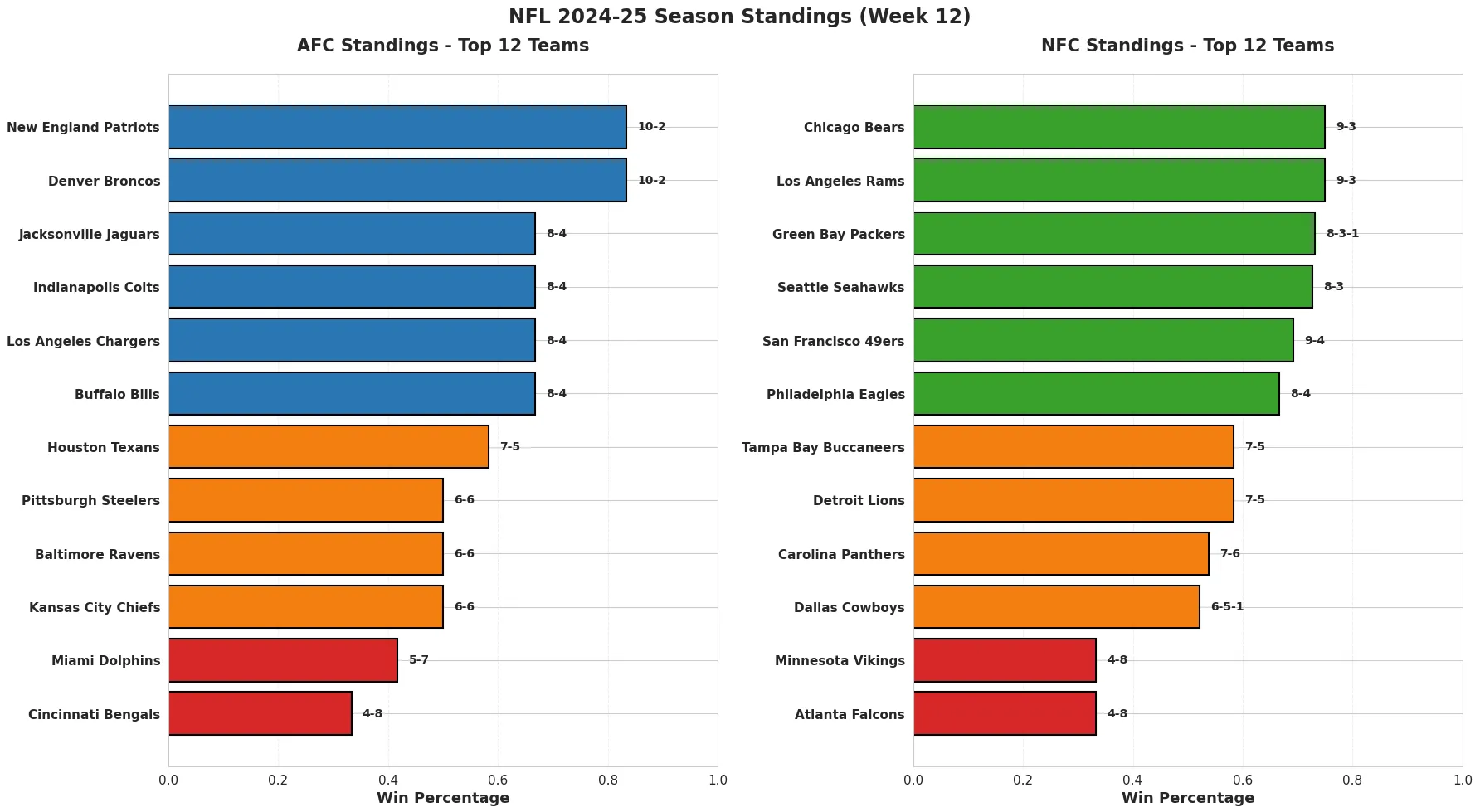
Let’s address the elephant in the stadium: the NFC is stronger this year.
Top NFC teams are more balanced and experienced. The Eagles, Rams, and Lions all bring different strengths but share one commonality, they’ve been here before (at least organizationally, even if specific rosters have turned over). That matters when December pressure mounts and playoff races tighten.
The AFC feels uncertain beyond Buffalo and Denver. Kansas City is always dangerous because Patrick Mahomes exists, but they’re not the juggernaut they’ve been in recent years. The rest of the conference? Wide open, which creates chaos but not necessarily quality.
Conference strength impacts Super Bowl odds because the path matters. If the NFC Championship Game is effectively the real championship (think early 1990s when the NFC dominated), then emerging from that conference battle-tested makes you the favorite regardless of who survives the AFC.
The NFC is stronger this year.
Dark Horse Alert: The Denver Broncos
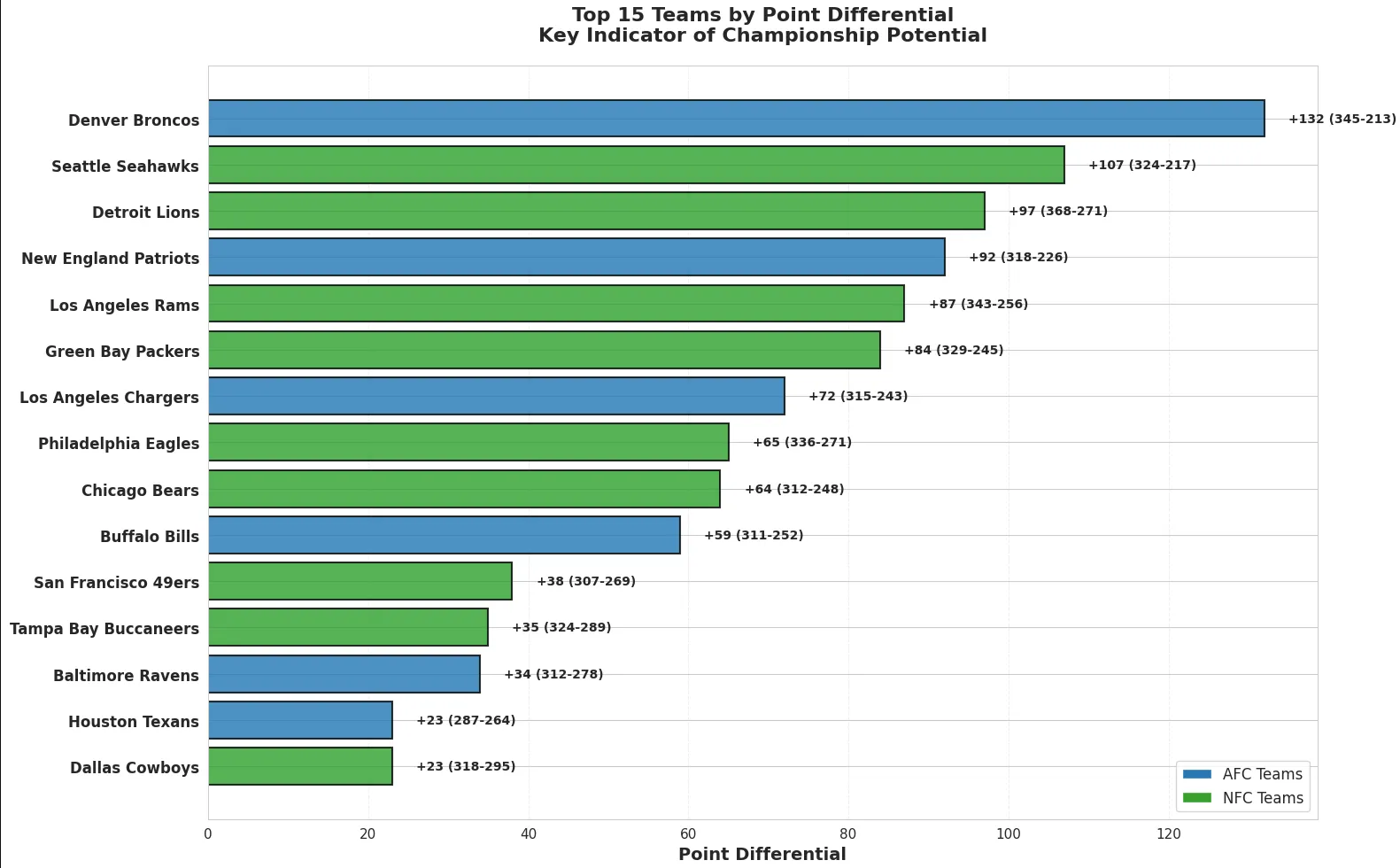
That +132 point differential isn’t a fluke. This team dominates opponents in a way that suggests structural superiority, not luck. Their defense is suffocating, forcing turnovers and creating short fields for an offense that’s more efficient than explosive but effective nonetheless.
The playoff experience concern is valid, you can’t teach what you haven’t learned. But sometimes fresh legs and hunger outweigh veteran fatigue and expectation weight. The Broncos don’t carry championship pressure. They’re playing with house money, which creates dangerous confidence.
Statistical models favor Denver for good reason. If Sean Payton can scheme them through the AFC playoffs, their style, defensive dominance, ball control, explosive plays when needed—travels well to neutral site Super Bowls where weather and crowd noise neutralize.
My head says Eagles. My gut whispers Broncos.
Must-Watch Players
Jalen Hurts
Remains the Eagles’ engine. He’s a proven playoff performer who makes plays with his arm and legs. Dual-threat quarterbacks create defensive nightmares because you can’t key on one dimension. Hurts in the red zone is basically unstoppable when the game plan leverages his rushing ability.
Drake Maye
Is the rookie sensation leading the Patriots’ surprise contention. He’s not carrying them to Super Bowl LX, but his development trajectory suggests New England might be back sooner than anyone expected. Keep an eye on him—this experience matters for future seasons.
Matthew Stafford
Brings that veteran calm that only comes from winning it all. He’s been the underdog, the bridesmaid, the guy who finally got his ring. That perspective keeps the Rams steady when chaos erupts. His 3,025 passing yards through 12 games shows he’s still got plenty in the tank.
Josh Allen
Is the MVP candidate everyone watches. When he’s playing hero ball and winning, Buffalo looks unstoppable. When he forces it and the turnovers mount? The Bills become beatable. That volatility makes them fascinating and frustrating simultaneously.
Jonathan Taylor
Is quietly carrying the Colts’ offense with those 1,139 rushing yards. If Indianapolis sneaks into the playoffs as a wildcard, he’s the reason why—and the reason they might upset a higher seed.
Expert Consensus
Betting markets have the Eagles at 6/1, Rams at 7/1, and Broncos at 8/1. Expert consensus mirrors this: Eagles first, Bills second, Rams third. Statistical models flip it slightly, favoring Denver’s dominance metrics over Philadelphia’s balance.
Our model, integrating all these factors plus injury reports, schedule strength, and championship score calculations—puts the Eagles on top with 72% confidence. That’s not certainty; it’s probability with caveats.
Key expert observations include praise for Philadelphia’s balance, concerns about Denver’s playoff inexperience, and questions about whether Buffalo can overcome mental hurdles. The Lions get love for offensive firepower but skepticism about their consistency.
The Prediction
Super Bowl LX: Philadelphia Eagles 27, Denver Broncos 24
This prediction assumes health, normal playoff chaos, and both teams navigating their conference championships successfully. It accounts for the Eagles’ experience edge, home-field advantage through the NFC playoffs, and Jalen Hurts’ dual-threat capabilities.
The Broncos keep it close because that defense is legitimate and Sean Payton is one of the league’s best strategic minds. But in a tight fourth quarter with everything on the line, experience wins. The Eagles have been here. They know what it takes. That knowledge becomes instinct in crucial moments.
Super Bowl LX MVP: Jalen Hurts, QB, Philadelphia Eagles
He’ll account for three touchdowns, two passing, one rushing, and make enough plays in crunch time to secure the hardware.
The Timeline That Matters
Weeks 13-14:
Division races heat up. Watch Eagles vs. Cowboys (NFC East implications) and Rams vs. Seahawks (NFC West chaos). These games determine seeding and momentum.
Weeks 15-16:
Playoff seeding solidifies. Teams start making decisions about player health vs. wins. Home-field advantage gets locked in or lost here.
Weeks 17-18:
The final push. Injury management becomes critical. Some teams rest starters; others fight for wildcard spots. Momentum matters heading into the playoffs—you want to be hot, not hobbling.
Wild Card Weekend:
Chaos reigns. Lower seeds upset higher seeds because anything can happen in one-and-done football. The Eagles and likely top AFC seed get rest while others battle.
Divisional Round:
Real contenders emerge. This is where pretenders get exposed and champions announce themselves.
Conference Championships:
January 25th-26th. The road to Santa Clara gets finalized.
Super Bowl LX:
February 8th, 2026. Levi’s Stadium. The culmination of everything.
How Livedocs Turns Football Fandom Into Football Analytics
You know what makes this kind of analysis possible? It’s not just watching games or reading box scores. It’s systematically integrating multiple data streams, running probability models, and synthesizing expert opinions into coherent predictions. That’s exactly what Livedocs enables for serious sports analytics work.
Think about everything that went into this Super Bowl LX analysis: Current standings and win probabilities from multiple sources. Championship scoring algorithms that weight various performance metrics. Injury reports that update constantly. Strength of schedule calculations. Expert predictions from ESPN, NFL.com, CBS Sports, and others. Historical playoff performance data. Point differential tracking across 12+ weeks of games.
Traditionally, you’d need different tools for each component, one database for stats, another spreadsheet for calculations, a third visualization tool for charts, and a word processor for the final report. Information gets siloed. Updates don’t sync. By the time you finish compiling everything, the data’s already stale because another week of games just happened.
Livedocs changes this by creating a unified workspace where data collection, analysis, and reporting happen simultaneously. The notebook structure lets you pull NFL stats using SQL queries, run Python-based probability models, generate visualizations of championship scores, and write analysis—all in the same environment.
Livedocs changes this by creating a unified workspace where data collection, analysis, and reporting happen simultaneously
Final Thoughts
As we head into the final weeks of the regular season and the playoffs approach, the teams that adapt fastest to changing circumstances injuries, momentum shifts, weather conditions will emerge victorious. The same principle applies to analysis: those who can process new information quickly and adjust predictions accordingly will stay ahead of the curve.
That’s exactly what Livedocs was built for, not casual browsing of stats, but serious analytical work that requires combining multiple data sources, running sophisticated models, and communicating findings clearly to diverse audiences.
To make your own analysis like this? Use Livedocs.
- 8x speed response
- Ask agent to find datasets for you
- Set system rules for agent
- Collaborate
- And more
Get started with Livedocs and build your first live notebook in minutes.
- 💬 If you have questions or feedback, please email directly at a[at]Livedocs[dot]com
- 📣 Take Livedocs for a spin over at Livedocs. Livedocs has a great free plan, with $10 per month of LLM usage on every plan
- 🤝 Say hello to the team on X and LinkedIn
Super Bowl LX Date: February 8, 2026 | Levi’s Stadium, Santa Clara, California
Whether you’re betting money, bragging rights, or just trying to understand why certain teams succeed while others stumble, the answer lies in the data. And the teams that master their data—both on the field and in the front office—tend to be the ones hoisting Lombardi Trophies in February.
Book it: Eagles over Broncos. See you in Santa Clara.
Ready to analyze your data?
Upload your CSV, spreadsheet, or connect to a database. Get charts, metrics, and clear explanations in minutes.
No signup required — start analyzing instantly