Honduras' 2025 Election Drama
November 30, 2025. That’s when Honduras went to the polls, and honestly? Things got complicated fast.
With only 34% of ballots counted as of December 1st, the race is tighter than anyone expected. Nasry Asfura from the National Party leads with 40.63%, but Salvador Nasralla from the Liberal Party is breathing down his neck at 38.78%. We’re talking about a margin of roughly 24,000 votes, a gap that could evaporate faster than morning dew in Tegucigalpa’s heat.
Here’s the thing: this isn’t just another election. It’s a referendum on Honduras’ future, wrapped in allegations of fraud, sprinkled with unprecedented US intervention, and served with a side of regional tensions that would make any geopolitical analyst nervous.
And here we are using Livedocs Deep Research Agent to pull up 20+ resources and data across the internet to do the analysis.
You can access the notebook here, this is the link
The Contenders
Let me break down the main players, because each one brings their own flavor of chaos to this electoral cocktail.
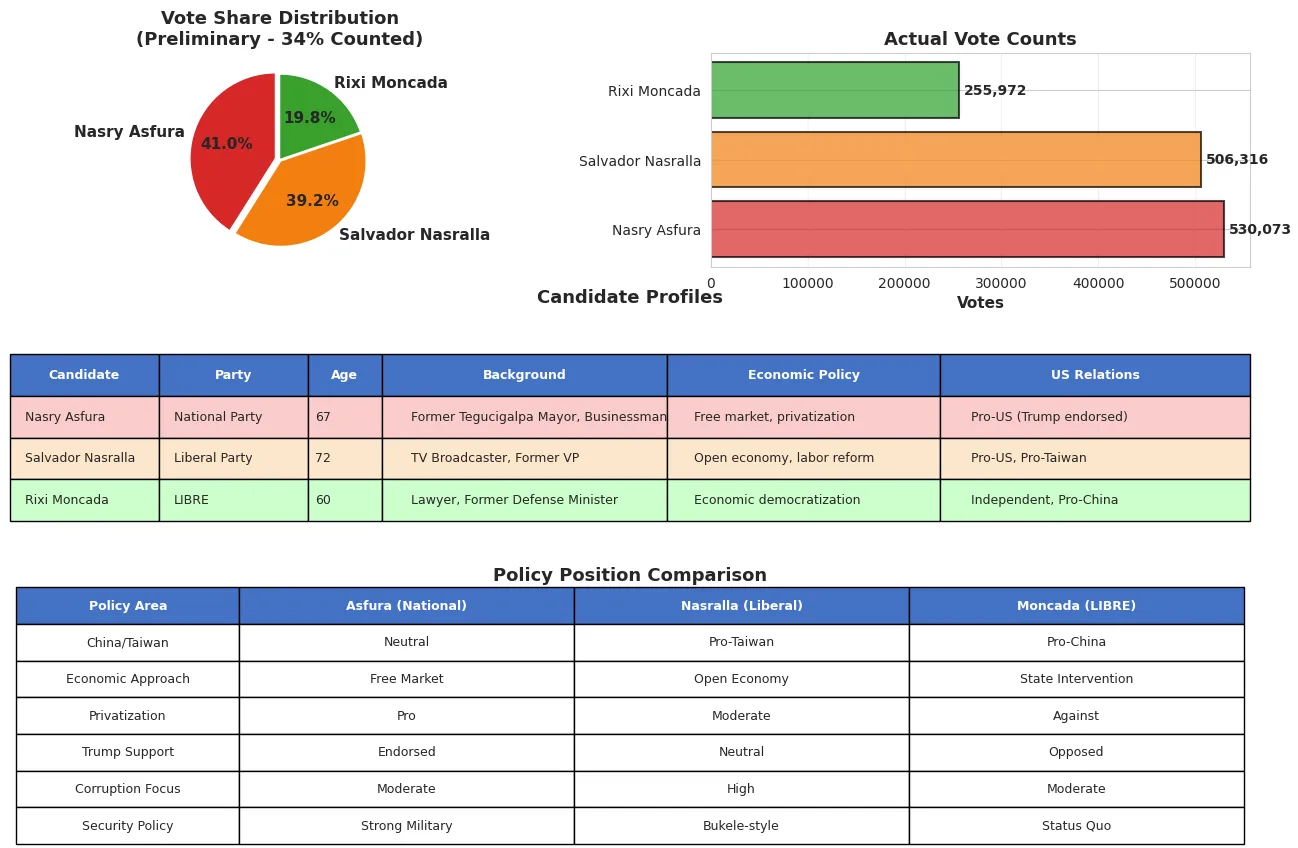
Nasry Asfura leads the pack right now. The National Party candidate and former Tegucigalpa mayor carries some serious baggage, corruption allegations from his time running the capital. But he’s also got something no other candidate has: a direct endorsement from Donald Trump himself. Yeah, you read that right. An American president weighing in on another country’s election isn’t exactly subtle diplomacy, but it’s 2025, and apparently we’re doing this now.
But he’s also got something no other candidate has: a direct endorsement from Donald Trump himself
The business community loves him. Private sector backing means resources, organization, and momentum. Plus, the National Party has this rural machinery that’s been humming along for years—think established networks in communities where every vote counts.
Salvador Nasralla isn’t going down without a fight. This Liberal Party candidate has something Asfura doesn’t: urban appeal.Cities are his stronghold, and if the remaining 66% of uncounted votes skew urban, we could be looking at a different winner by next week. He’s positioned himself as the reform candidate, the guy who’ll clean house without burning it down.
Then there’s Rixi Moncada, trailing at 19.59%.
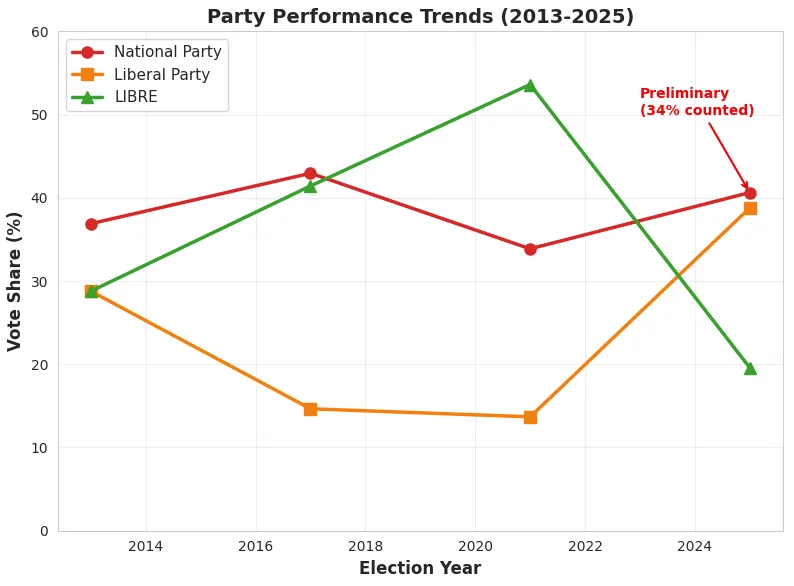
She represents LIBRE, the incumbent party that won in a landslide back in 2021 with 53.61% of the vote. That collapse—from majority winner to distant third, tells you everything about how disappointed voters are with the current administration. It’s not just a loss; it’s a repudiation.
The Numbers Game
You know what’s wild? With two-thirds of the votes still being tallied, this race is basically a sophisticated guessing game wrapped in statistical modeling.

Asfura’s 1.85, point lead looks solid on paper. But here’s where it gets interesting—that lead depends entirely on where the remaining votes come from. If they’re predominantly rural, Asfura strengthens his position. Rural Honduras has historically leaned toward the National Party, and their ground game in these areas is legendary.
But if those uncounted ballots lean urban? Nasralla could flip this whole thing. Cities broke for him, and urban turnout tends to get counted later because, well, there are just more people and more ballots to process.
Pre-election polls showed 34% of voters were undecided. Think about that for a second, more than a third of the electorate walked into voting booths without a clear preference. Their choices are now embedded somewhere in that pile of uncounted ballots, and nobody really knows which way they broke.
The math is straightforward but the implications are enormous. Asfura needs the rural vote to hold. Nasralla needs the urban count to overwhelm. And Moncada? She’s watching her party’s relevance evaporate in real-time.
The Trump Factor
Let’s talk about the elephant. or should I say, the donkey? in the room.
Donald Trump endorsed Asfura directly. This isn’t some vague statement of support or diplomatic platitude. This is the US president putting his name behind a specific candidate in another sovereign nation’s election.
The implications are staggering. For voters who see the US as Honduras’ primary economic and security partner, Trump’s endorsement carries weight. For those who bristle at external interference—and there are many, it’s fuel for nationalist sentiment.
This intervention creates bilateral tension regardless of who wins. If Asfura takes it, he’ll be seen as Washington’s man, which complicates his ability to act independently. If Nasralla wins despite Trump’s backing, US-Honduras relations start on an awkward foot. And if the election is contested? That tension multiplies exponentially.
Business Implications (Follow the Money, Always)
Honduras is Central America’s second-largest economy, and the business community isn’t just watching this election, they’re actively shaping it.
The private sector’s backing of Asfura signals their preference for market, friendly policies. They want stability, predictability, and policies that won’t rock the investment boat. Asfura represents that continuity, a known quantity with established relationships in the business world.
But here’s where risk analysis gets tricky. Let’s break down the scenarios: If Asfura wins: US relations improve, pro-market policies get implemented, and the investment climate stabilizes. Risk level? Moderate. The corruption allegations don’t disappear, and anti-government sentiment won’t evaporate overnight.
If Nasralla wins: US relations stay maintained but not strengthened. Reform focused economic policy could mean some disruption but nothing catastrophic. Investment climate remains stable with a low-to-moderate risk level. He’s not looking to upend the system—just fix the broken parts.
If Moncada somehow pulls off a miracle: US relations deteriorate, economic policy becomes more interventionist, and investment climate enters uncertain territory. High risk across the board.
If the election is contested: All bets are off. Volatile relations, paralyzed economic policy, poor investment climate, and very high risk. This is the nightmare scenario that keeps business leaders up at night.
The Shadow of 2017
Anyone following Honduran politics remembers 2017. Disputed results, mass protests, government crackdowns, the works. That election left scars on the national psyche, and those wounds haven’t fully healed.
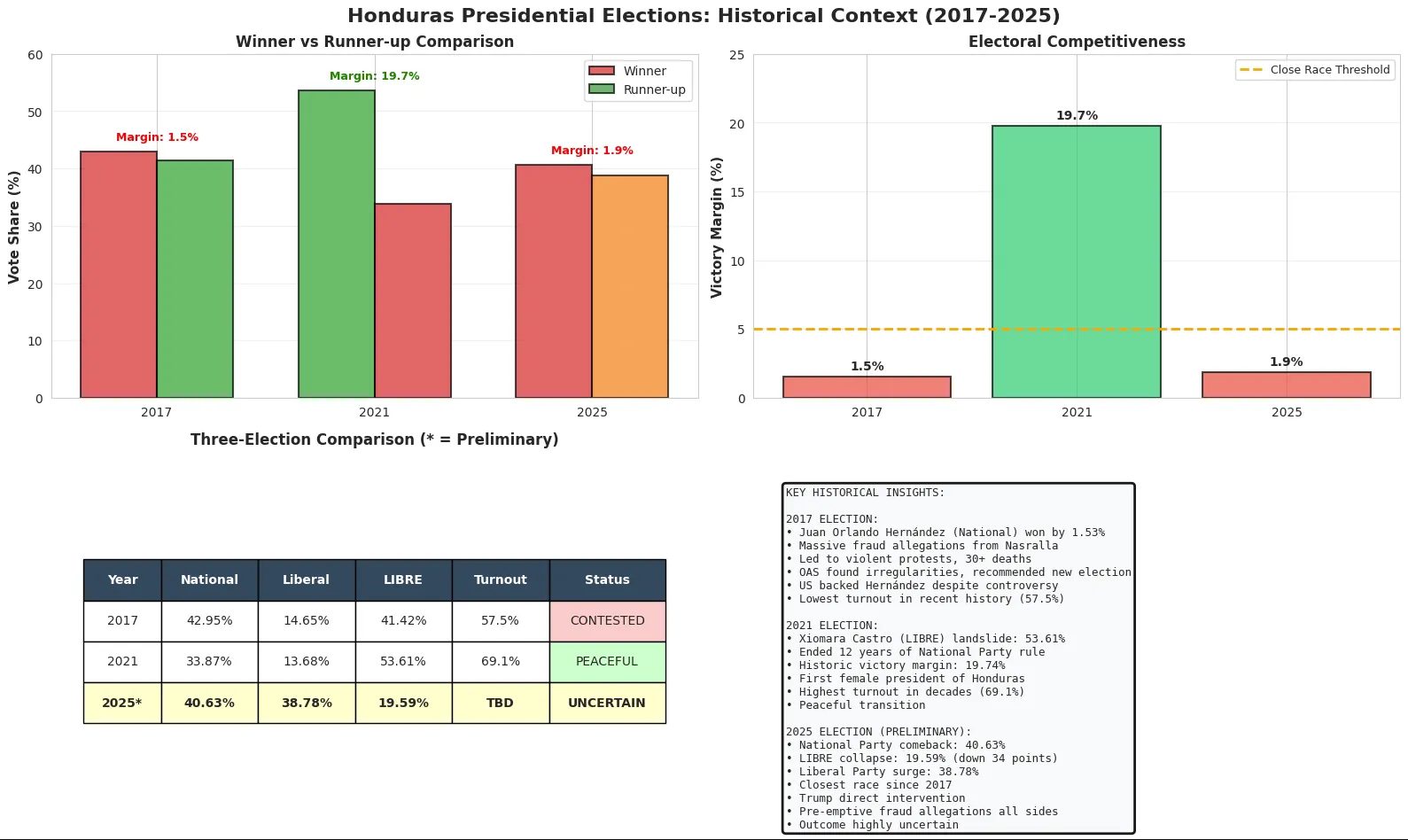
With all three major candidates pre-emptively claiming fraud, we’re potentially headed down a similar path. The National Electoral Council’s credibility is paramount here, but it’s already fragmented. International observers from the OAS, EU, and US are monitoring closely, which adds legitimacy but also pressure.
The risk of post-election violence isn’t hypothetical, it’s probable. Honduras has a history of protests turning violent when legitimacy comes into question. Security forces tend to crack down hard, which escalates tensions further, which justifies more crackdowns, and suddenly you’re in a cycle that’s really hard to break.
Regional Spillover
Honduras doesn’t exist in a vacuum. Venezuela and Nicaragua connections could escalate tensions quickly if this election goes sideways. Regional actors have interests here—some want a stable, US-friendly Honduras, while others would prefer to see American influence weakened.
The next 60 days will determine not just Honduras’ trajectory for the next four years, but potentially shift regional dynamics in Central America. That’s not hyperbole—that’s the reality of interconnected political ecosystems.
What Happens Next?
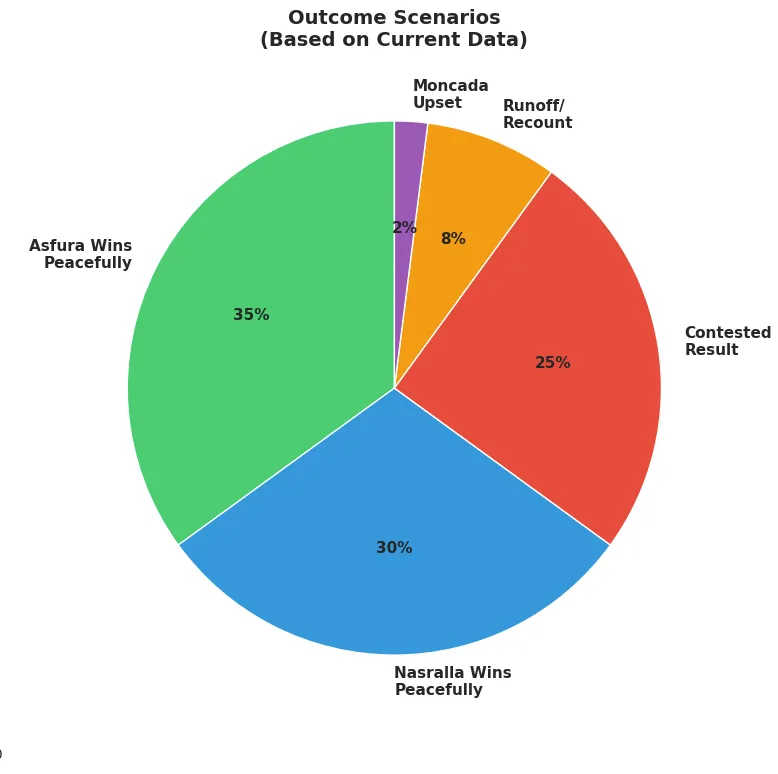
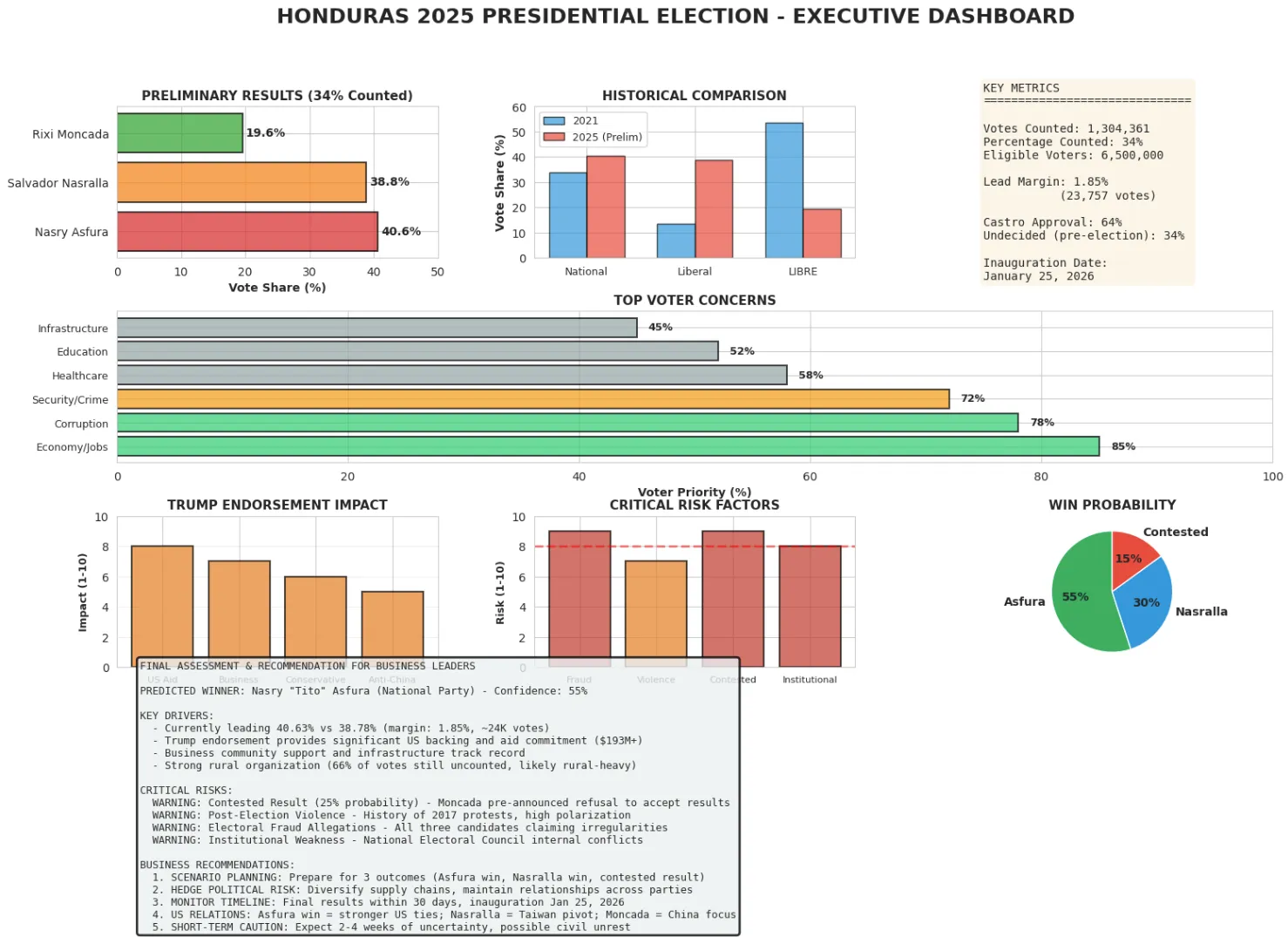
Final result certification is expected mid-December. Until then, we’re in limbo. The remaining votes will either confirm Asfura’s lead or reveal a Nasralla surge. The Electoral Council will either maintain its credibility or see it collapse under the weight of competing fraud allegations.
International monitors will either validate the process or raise red flags that could delegitimize whoever wins. And the losing side will either accept defeat gracefully (unlikely) or contest the results (very likely).
For businesses operating in Honduras or considering investment, the safest approach is to prepare for volatility while staying engaged. Political transitions create both risks and opportunities, those who navigate them skillfully emerge stronger. Those who panic or freeze tend to get left behind.
How Livedocs Made This Analysis Actually Possible
Creating a comprehensive analysis like this, pulling together electoral data, candidate profiles, historical context, risk assessments, and business implications—used to require a team of analysts working across multiple tools for days, maybe weeks.
That’s where Livedocs comes in as an AI-powered collaborative workspace that combines notebook capabilities with the simplicity of app builders, specifically designed for serious data analysis. Think about what this Honduras election analysis required: real-time data from the National Electoral Council, news aggregation from multiple sources (AP, BBC, Al Jazeera), historical election data for comparison, demographic breakdowns, and risk modeling. Traditionally, you’d need separate tools for each component—one for data collection, another for analysis, a third for visualization, and a fourth for report generation.
Livedocs lets you seamlessly switch between SQL and Python in the same notebook while passing data effortlessly, which means you can query databases, run statistical models, and generate visualizations without ever leaving the platform. The Honduras analysis notebook demonstrates this perfectly, pulling live election data, running comparative analysis against 2021 results, and generating risk matrices all in one place.
The AI integration is where things get really powerful. The platform provides one-shot answers from your data with full context, automatically fixes SQL queries and Python code, and explains complex work to stakeholders in plain language. For political analysis like Honduras’ election, this means you can ask questions like “What’s the vote margin in urban vs. rural areas?” and get instant visualizations without manually coding every query.
Final Thoughts
Serious data analysis needs serious tools, not toys. Chat-with-your-data tools aren’t built for this level of work—they’re simple interfaces, not robust analytical playgrounds. When you need to track election results as they update, model different outcome scenarios, assess regional spillover risks, and package everything into a coherent report, you need something purpose-built for that complexity.
The fact that this Honduras analysis includes real-time updates (as of December 1, 2025), maintains data source transparency, and provides actionable intelligence for business decision-makers shows what’s possible when you have the right infrastructure. Livedocs doesn’t just make analysis easier—it makes certain types of comprehensive, real-time analysis actually feasible for teams that don’t have dedicated data engineering departments.
To make your own analysis like this? Use Livedocs.
- 8x speed response
- Ask agent to find datasets for you
- Set system rules for agent
- Collaborate
- And more
Get started with Livedocs and build your first live notebook in minutes.
- 💬 If you have questions or feedback, please email directly at a[at]Livedocs[dot]com
- 📣 Take Livedocs for a spin over at Livedocs. Livedocs has a great free plan, with $10 per month of LLM usage on every plan
- 🤝 Say hello to the team on X and LinkedIn
Stay tuned for the next article!
Data sources: National Electoral Council of Honduras, Associated Press, BBC, Al Jazeera, AS/COA, WOLA
The Honduras election will eventually have a winner. But regardless of who takes office in January, the real winner might be the tools and technologies that let us understand complex political dynamics in real-time, turning raw data into actionable intelligence faster than ever before.
Ready to analyze your data?
Upload your CSV, spreadsheet, or connect to a database. Get charts, metrics, and clear explanations in minutes.
No signup required — start analyzing instantly